
“Accountable AI” has become easy to say. Most AI vendors now use some version of it. For a licensed operator, the real test is simple: when a regulator asks about something your AI did, can you answer?
Accountable AI is AI whose every action can be traced to a policy, an approval, and a record, so the organization running it can explain and defend each decision to a regulator, an auditor, or a customer.
In iGaming, that standard matters more than almost anywhere else. Operators hold licenses in multiple jurisdictions, each with its own rules on player protection, data handling, and outsourcing. When an AI system performs well but can’t show its work, the license holder carries that risk alone.
The idea has broad backing. The OECD AI Principles name accountability as a core principle: the organizations that deploy and operate AI should be held accountable for how it functions.
In brief
- Accountable AI ties every action to a policy, an approval, and a record.
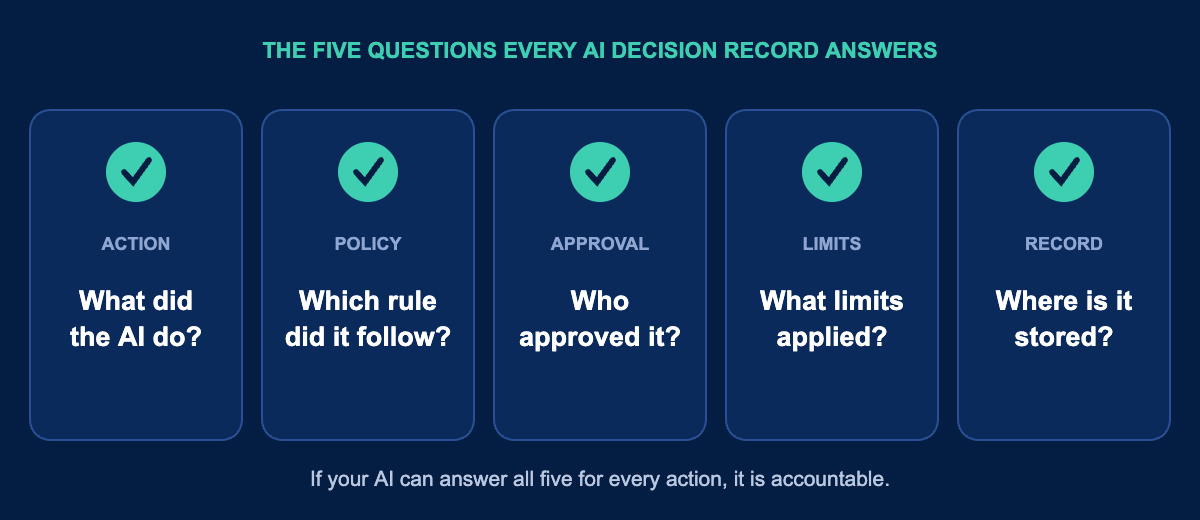
- In practice, it comes down to five questions: what the AI did, which rule it followed, who approved it, what limits applied, and whether you can prove it later.
- For multi-jurisdiction operators, those rules and records have to adjust to each license.
Five questions accountable AI has to answer
The definition becomes practical when you turn it into questions. These are the ones a regulator, an auditor, or your own compliance team will eventually ask.
1. What did it do?
Every action needs a complete record: what the system received, which systems it touched, and what it produced. That record should be readable by a compliance officer as well as an engineer. Record-keeping is already written into regulation. The EU AI Act, for example, requires high-risk AI systems to automatically log events over their lifetime.
2. Which rule did it follow?
Each action should tie back to the policy that permitted it. A policy-aware system checks the relevant rule for that jurisdiction before it acts, and records which rule applied.
3. Who approved it?
Some actions should never run on their own. Refunds above a threshold, changes to a player account, and access to sensitive data are common examples. Accountable AI routes those to a named person and records the approval. Where a human steps in is set by policy, market by market. The EU AI Act takes a similar view, requiring high-risk systems to be designed for effective human oversight.
4. What was it allowed to do?
Regulators want to know the guardrails existed before the action happened. That means clear limits on what the AI can do, enforced by the system itself and visible in the record.
5. Can you show it again next year?
Audits happen long after the work is done. Evidence has to be retained, retrievable, and consistent, even if the underlying AI model has changed since. A model-agnostic approach keeps the record in the same shape whichever model did the work.
Why is accountable AI hard to achieve?
Accountability is hard to add after the fact. Most general-purpose AI tools were designed for markets where nobody asks how a decision was made, so governance arrives later as logging and dashboards. That produces plenty of activity data. It rarely gives a clear answer to the questions regulators are asking.
Multi-jurisdiction operations raise the bar further. The same action can be routine in one market and require sign-off in another. Accountability has to follow the license, so the rules, approvals, and records adjust to each jurisdiction the operator serves.
What does accountable AI look like in daily operations?
Day to day, accountable AI looks like routine work done automatically, with the rules, approvals, and records handled along the way. Take two everyday workflows where AI applications are already doing useful work.
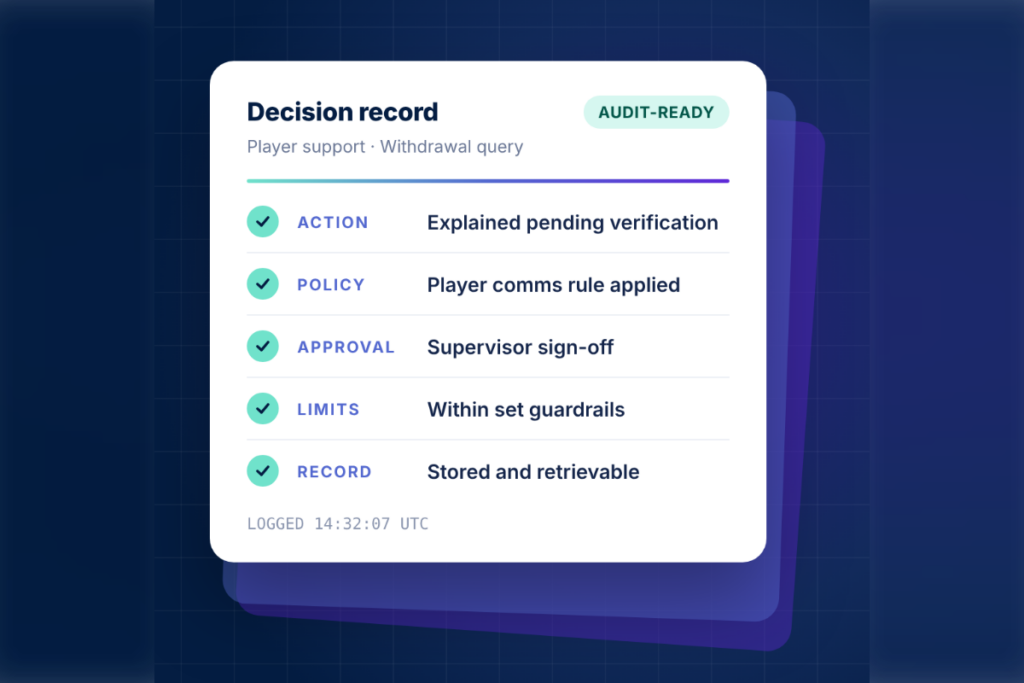
Player support. A player asks why a withdrawal is delayed. An AI app checks the account, finds a pending verification step, and drafts a clear explanation with next steps. In a market where that response needs review, it goes to a supervisor first. The steps taken, the policy applied, and the person who approved it all land in one decision record.
IT helpdesk. An employee requests access to a reporting system. The AI app confirms their identity, checks the access policy for their role, and grants or escalates the request. If an auditor later asks who had access and why, the answer is already written down.
In both cases the AI handles the routine work, and accountability comes built in.
Accountable AI ties every action to a policy, an approval, and a record.
How does Future8 deliver accountable AI?
Future8 was built around these five questions from the start. FuturePath AI provides pre-built AI applications, powered by coordinated agents, already running governed and auditable operations inside Fortune 500 enterprises. Continent 8 Technologies brings 28 years of operating within iGaming’s regulatory frameworks across more than 100 locations worldwide.
Together, they make every action policy-aware, auditable, and defensible to the regulator. Regulatory standing, wherever the workload runs.
A practical place to start: ask these five questions of any AI system you run today, or plan to. Where the answers are hard to give, that is the gap to close first. Our AI Readiness Assessment is built to find those gaps and map where AI can be deployed and how it will be evidenced.
Frequently asked questions
Is accountable AI the same as explainable AI?
Explainable AI focuses on why a model produced a particular output. Accountable AI covers the full action around it: the policy that applied, who approved it, and the record that was kept. Explainability is one part of accountability.
Does accountable AI mean a person approves every action?
No. Routine, low-risk work can run automatically within set limits. Approvals are reserved for actions that policy or regulation says need human sign-off, and those thresholds can differ by jurisdiction.
Why does accountable AI matter in iGaming?
Operators hold licenses in many jurisdictions and answer to a regulator in each one. When AI acts on a player account or an internal system, the operator has to show what happened and why, in every market where it holds a license.